Wudang Taoist Martial Arts School
Showing 1 to 1 of 1 (1 Pages)
Wudang Taoist Martial Arts School
|
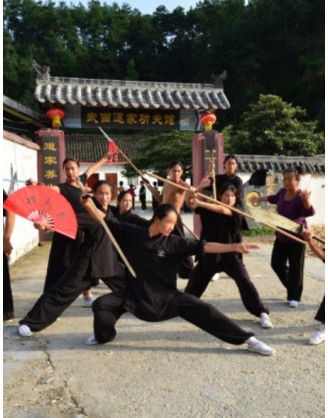
The Wudang Daoist Martial Arts Academy is located at the Temple of the Returning Dragon (Huilong Guan 回龙观), high up in Wudang Mountains. It was founded by Master Chen Shiyu in 2007. Master Chen Shiyu has been training in Wudang Shan for over 20 years and is a 15th Generation Master of Zhang San Feng Wudang Kung Fu. We are a small school, and have a peaceful environment here. Here we live a Daoist way of life, and strive to be close to nature. Our school is somewhat hidden, and no tourists come here. We accept students that are coming short term, and those looking for rigorous traditional programs that last several years. Our school typically has less than 30 students in total. We welcome people of all ages and ability, only we wish that they strive to work hard to discover the true Wudang Kung Fu. Our method of training is traditional, which can be difficult but very effective for hardworking students. We hope that students who come here can strengthen their body, learn techniques for inner cultivation, and come to a deeper understanding of traditional Daoist culture.
Wudang Kung Fu
Wudang Kungfu is one of the two major families of Traditional Chinese Martial Arts, the other being Shaolin. It is an internal style, meaning that not only does it require great physical strength and fighting ability, but it also has a strong focus on using the mind, and one’s “Qi”, to cultivate and control the body. Its purpose is threefold: It is an effective combat technique, it is a form of body and mind cultivation, and it is an art – containing thousands of years of traditional Chinese culture. Wudang Kung Fu contains profound Chinese philosophical theories, combining the traditional concepts of Taiji (Tai Chi), Yin and Yang, Wu Xing (Five Elements), and the Ba Gua (Eight Trigrams) into boxing theories, boxing skills, exercises and attack strategies, all derived by studying the laws of life and nature. Wudang Kungfu (neijia quan internal boxing) is featured by overcoming motion with stillness. The opponent will be laid down the moment he attacks. It is apparently different from Shaolin which is classified into external type boxing. Internal Gongfu was created by Zhang San-feng, a famous Taoist in the Song Dynasty. Wudang Kung Fu contains many skills and training methods designed for keeping healthy and prolonging one’s life while at the same time collecting many effective fighting methods. It is not only one particular school of martial arts, but also a complete system for both self defence and health preservation.
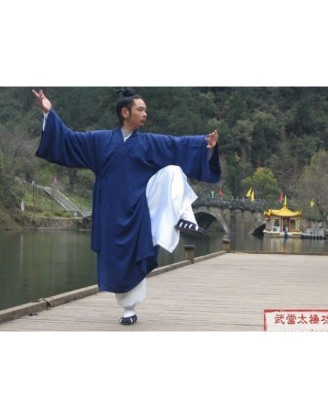
Wudang Taiji Tai Ji is originated from Infinity. It is the basis for all movement and stillness. It is the originator of the Two Extremes (Yin and Yang). Tai Ji was formed from Infinity by separating Yin and Yang. Yin and Yang are the equal and opposite pair. Sometimes Yin stands for female and Yang stands for male. In Tai Ji, Yin represents stillness and Yang represents movement. The workings of the universe is based upon Yin and Yang.
In Tai Ji, there is stillness in movement and movement in stillness. The two are interconnected and should not be separated. Internal power is through control of the mind. Concentration of mind moves the internal energy prior to any external movement.
Taijiquan is not simply the exercise for elderly, which is perhaps what is known to Westerners. It is in fact a combination of Yin and Yang, Tai Ji and Infinity. It is an art requiring perfect control of mind. It integrates stillness and movement, from external to internal, from movement to stillness, from elementary to advanced, and merging stillness with movement. Taijiquan not only directs internal power to external movements, it combines the mind with breathing, resulting in good health and an art of combat applications.
There are 13 postures (8 hand/arm movements and 5 body movements) in Tai Ji. The 8 hand/arm movements: Beng, Lu, Ji, An, Zai, Lie, Zhou, and Gao. In simplified terms, they mean: ward off, pull back, push, press, oblique turning, twist, elbow strike, and shoulder strike. The 5 body movements are directional. They are: advance, retreat, shift to the left, shift to the right and stable equilibrium. The 13 postures are based on the 8 trigrams and 5 elements. Requirements include relaxing, body coordination, concentration of mind, and stillness in movement.
Taijiquan is a stepping-stone to Daoism. In Daoism, one has to train one’s behaviour and mind. It is important to keep a peaceful mind. Through meditation, combining Yin and Yang, and stillness in movement, the internal power will flow through the whole body achieving the ultimate aim.
Qigong Qigong is an ancient Chinese practice for cultivating the body energy, for the benefits of the physical body, mind and spirituality. Qigong practices are varied. They include hard and soft qigong, healing qigong, and general toning qigong. Wudang Qigong is an “earlier heaven” method based on traditional Chinese medicine (TCM) principles and teachings. Qigong is a good practice for everyone, at any age to keep healthy in both body and mind. People’s Life and Death, Connection to Life, Dao of Life, Dao of Cultivation, Beginning of Life, Stairs of Immortality.
The character sits in the heart. The initial spirit within the heart is sent out through the eyes. The character in the heart is moving like an ape. The life lies in the kidneys. The initial energy within the kidneys is sent out by the root of excess and the character of heart. The thoughts are running like a horse.
This is called “xinyuan, yima”.
Take back xinyuan, yima will follow.
The ancient practitioners took back heart and will, and stabilised the jing and nurtured the qi; made the qi of the breath like the wind and the the qi of real yang like the fire. In practising and heating, they transformed jing to qi, and qi to shen; let energy concentrate, and united with the nature of Dao. The methods of practice are immeasurable, there are methods of movement, stillness, sitting and laying, but never stick rigidly to given patterns – you can hardly understand the everything.
Wudang Taoist Martial Arts School, Huilongguan, Wudangshan Scene
|