
Kunlun School

Showing 1 to 6 of 6 (1 Pages)
Kunlun School
|
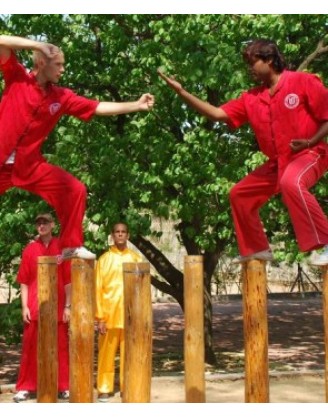
Kunlun Chinese traditional martial arts school is located in east Yantai Shandong Province, China located at the feet of the Kunyu Mountains. The Kunyu Mountains are known as one of the most famous Taoist mountains in China, the birthplace of Quanzhen Taoism. A wide variety of areas of interest and natural beauty can be found here such as the Top of Taipang, Yanxia Cave, Dragon Pools, Yuegu Palace, Wuran temple and the holy classics hill.
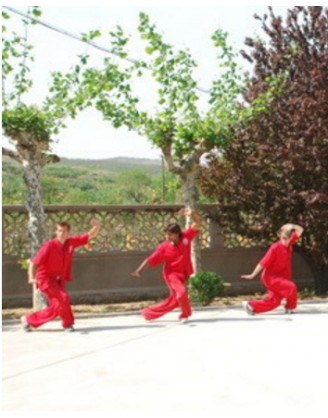
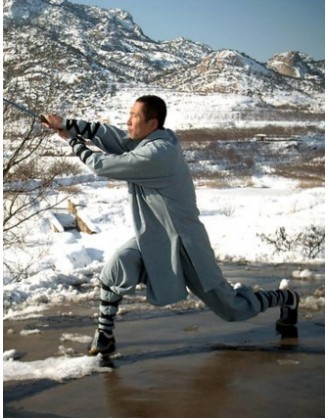
School of traditional Taoist practices and the result of my efforts over a half a lifetime of training in the development of body, mind and spirit. I am a traditional teacher of a complete system of Taoist arts called the KUNLUN System named for the famed Kunlun Shan mountain range in China, also known as the mountain of the immortals. I also offer accompanied self healing practices both traditional and alternative like purification and detoxification, nutritional support and plant medicines in addition to the ancient Taoist Kungfu Tea ceremonies and skillful tea making classes. The school teaches Taichi, Shaolin, Qigong, Praying Mantis, Bagua, and Xing Yi Quan. You can also learn to use a number of weapons weapons including the sword, spear, straight sword and staff.
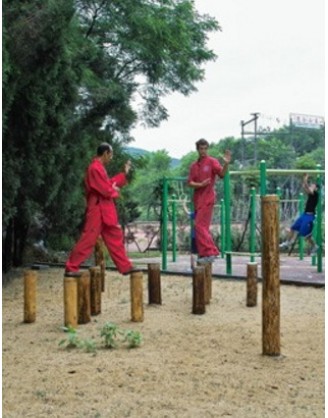
Kunlun International Martial Arts School is a traditional Chinese kung fu school in rural Yantai. The school ajoins and uses the facilities of an ex-military base so as a result has excellent facilities. The school employes translators and has support staff in Yantai City. The School specialises in Seven Star Praying Mantis Boxing, Plum Blossom Praying Mantis Boxing, and Throwing Hand Praying Mantis Boxing as well as traditional Shaolin Kung Fu, Qi Gong and internal styles such as Bagua, Chen Style, Tai Chi and Xing Yi.
The location of the school in the beautiful Yantai countryside adds to students learning experience as there are few distractions here, except the bustle of Chinese rural life and the rustic charm of the locals.
Styles:
TANGLANG
Northern Praying Mantis (螳螂拳, Tanglangquan) originated in Shandong province. The style is considered internal-external. It is accessible to and effective for beginners, but also contains refined skills requiring many years to master, and yielding very high levels of martial ability and internal development. According to one legend, Tanglangquan was created by Wang Lang (王朗) inspired by observing the praying mantis. But it is not a pure animal style; it does not copy the movements of the mantis directly, but emulates its aggressive attitude, and combines upper body movements inspired by the angles of the mantis’ strikes with footwork derived from a monkey style of kung fu. Another legend has it that Wang Lang was among 18 martial artists summoned by the Abbot of Shaolin to improve the styles taught there, and absorbed and incorporated the best of their teachings.
Praying Mantis demands that the major joints and spine remain flexible during practice, making it effective for promoting health and longevity. Its hand movements are mainly fast and continuous circular blocks and counters, highly effective for self-defense, alternating between upward and downward movements. The movements are hard but not stiff, soft but powerful, rapid but orderly, with many abrupt changes, and different positions adopted for different situations. Use of power is abrupt and quick, alternating tension and relaxation. There are short-range and long-range attacks, often combined with step and leg techniques for added effectiveness. Over the centuries, Preying Mantis Kung Fu has evolved numerous sub-styles. The original, oldest – over 350 years old – and ‘hardest’ – although still internal-external – of these, is Qixing Tanglangquan (七星螳螂拳 – Seven Star Praying Mantis). This is now very widespread in and outside Shandong, but within Shandong later developed into Meihua Tanglangquan (梅花螳螂拳 – Plum Blossom Praying Mantis) along with Taiji Tanglangquan (太極螳螂拳 – Taiji Praying Mantis). Around one hundred years ago these styles were merged into Taiji Meihua Tanglangquan (太極梅花螳螂拳 – Taichi Plum Blossom Praying Mantis Boxing). Shuaishou Meihua Tanglangquan (摔手梅花螳螂拳 – Flicking/Throwing Hand Plum Blossom Praying Mantis) is a further offshoot of Meihua Tanglangquan, which Qu Shifu has merged with Taiji Meihua Tanglangquan, to form his personal style: Shuaishou Taiji Meihua Tanglangquan (摔手太極梅花螳螂拳)
SHAOLIN
Shaolinquan (少林拳) is perhaps the oldest and most famous martial art, gradually developed in the Buddhist Shaolin Temple at Songshan (松山 -Mount Song), in Shandong’s neighboring Henan province, from 495 AD.
Legends of the roots of the Shaolin kung fu abound. According to one, the first Buddhist monk in Shaolin, and Indian monk Buddhabhadra (Mandarin: Batuo – 跋陀) had two Chinese disciples who were already very talented martial artists, who started to fuse Buddhist mental techniques with martial practices.
But perhaps they didn’t get very far: when Bodhidarma (Mandarin Damo 達摩), came to Shaolin some 60 years later, legend has it that he was so disgusted with the poor physical condition of the monks that he sat in meditation for nine years in a mearby cave. The result of this meditation: Zen (Mandarin: Chan – 禪) Buddhism, and two manuals – “Tendon Changing Scripture” (Yijinjing – 易筋经) and “Marrow Clensing Scripture” (Xisuijing – 洗髓经) – for sets of exercises, carried down to the present day. These concentrate on physical and mental well-being, respectively. In any case, after Damo the die was set: martial art and Chan Buddhism were inextricably linked.
Shaolin kung fu now has hundreds of styles, each of which has one or several forms – including empty-hand forms, animal forms, weapon forms as well as the famous drunken style – containing movements with more or less obvious combat applications, and sometimes therapeutic value. Shaolin monks master a large number of styles.
Since the Temple was first destroyed in the 14th century at least Shaolin kung fu has also been practiced outside Shaolin Temple, among lay people. In this environment, with more contact with other kung fu styles, and often less opportunity for intensive practice, the Shaolin styles have evolved. As such, they are probably less ‘pure’ than the Temple styles, but with an added emphasis on practicality and accessibility. And it seems possible that some styles lost to the monks may have survived as closed-door or family traditions, only to reappear as the State’s hostility to traditional Chines kung fu has declined in the last decade or two.
YONGCHUN
Wing Chun (Mandarin: Yongchun 咏春) is a semi-internal Southern Chinese Martial art. Popularised by Bruce Lee in the 1970s, it is perhaps the style of traditional Chinese kung fu most widely taught outside China, and most responsible for international interest in martial arts in general, and traditional Chinese martial arts in particular. While the popularity of Bruce Lee’s films, and the large Southern Chinese diaspora populations in the West were important in popularising Yongchun, it’s efficacy, elegance and accessibility probably account for it’s continued widespread popularity. Wing chun favours high toe-in stances, relaxed short-range vertical punches and low kicks and emphasises dominating the centreline – forcing opponents to use slower hooking punches – and hand-trapping – for opponents who insist on vying for the centreline. In the words of Bruce Lee’s teacher, Ip Man, the Yongchun fighter “Greets what arrives, escorts what leaves and rushes in upon loss of contact(來留去送,甩手直衝)”. Yongchun has three empty-hand forms, the first of which is relatively static and basic – analagous perhaps to the standing meditation (zhanzhuang – 站桩) training of several purely internal styles – progressing to more varied, mobile sets. A further form, practised on a wooden dummy – available both in and out of doors at Kunlunshan School – refines student’s understanding of angles, positions, and footwork, develops full body power and conditions striking surfaces. The two weapons forms employ a pair of short, heavy ‘Butterfly’ swords and a long-pole – the latter perhaps reflecting the style’s likely origin among boat-based itinerant performers. Aside from their direct utility, both weapons forms serve to further develop aspects off body mechanics (身法 – shenfa) used in Wing Chun’s empty-hand techniques. Along with these forms and single movements, Yongchun training also includes ‘sticking hands’ or chisau (Mandarin: chishou – 黐手), sensitivity drills like Taiji’s tuishou, designed to allow practitioners to spontaneously identifying opportunities to apply the techniques in their arsenals.
XINGYI
Xingyiquan (‘Form-Intention Boxing’ – 形意拳) is one of the oldest Traditional Chinese Martial arts, and the oldest widely recognised ‘internal’ style. The literal translation ‘Form-Intention Boxing’ – quite opaque as it stands – probably refers to the ability of the mind to mirror an intention in the body, as a physical form (or movement). Traditionally associated with Yue Fei – semi-legendary General and patriot of of the Southern Song Dynasty – nine centuries ago, some of Xingyi’s movements indeed have links with battlefield spear-fencing movements. And one of the style”s maxims – “Xingyi has no retreat” (形意没有退步) may hark back to days where Chinese spear-soldiers fought in phalanxes – with no option of retreat available to those on the front line, and good reason to focus on quickly eliminating their opponent down. But Xingyi Quan also shares similarities and lineage with the older, similarly named Xinyiquan (‘Heart-Mind Boxing’ – 心意拳), likely the traces of the older style’s influence. Xingyi can be well suited to students coming from more external styles, who can find that practice of Xingyiquan at normal speed hits a spot Taichi’s slow-motion forms cannot reach. But hidden within the apparently linear techniques of hsing-i are many subtle circular movements, not generally present in more external martial arts. Successful exploitation of these ‘internal movements’ for power-generation depends on relaxation, chi (qi – 气) and stillness of mind; the wide recognition of Xingyi Quan as an internal style is well-deserved. The internal aspects and practices of the style preserve its martially efficacy into old age, and provide health benefits that most external martial arts lack.
BAGUA
Bagua Zhang (八卦掌- eight trigram palm) one of three canonical Wudang neijiaquan (内家拳 – internal martial arts), can be traced back to Dong Haichuan (川海董), who appears to have synthesized elements of pre-existing martial arts with Daoist meditation and daoyin (导引 – internal cultivation) practices. The end product is a style that combines uniquely evasive circular footwork, derived from Daoist circle-walking – exhaustive practice of which nurtures the ability to effortlessly flow around and between attackers –
with palm strikes, joint locks and throws powered by smooth whole body coiling and uncoiling actions to devastating effect – even in face of numerous of opponents. Along with palm forms, and the commonplace staff, spear and sword, Bagua’s syllabus includes more unusual weapons, falling into two distinct camps: the easily-concealed – crescent “deer-horn knives” and “judge’s pens” – perhaps for bodyguards turned assasin – and the extremely large and heavy – Bagua sword and broadsword – for functional strength training synergistic with the more subtle empty- hand sets. Perhaps it is the breadth of this weapons syllabus that accounts for Bagua Zhang practitioners’ famed ability with weapons improvised from everyday objects.
Many consider Bagua to be the most difficult of the three main internal styles, and its skills are difficult for many to master well enough to use in self defense. But even at less exhalted levels of accomplishment, Bagua’s singular training practices yield great benefits in terms of coordination, flexibility of muscle and fascia, strength and joint stability, stamina and concentration, which can be helpful in the study of less intricate styles.
Bagua is often associated with Beijing – where Dong Haichuan taught the Imperial bodyguard and had numerous disciples – and nearby Tianjin – whose lawlessness in the late 19th century spawned bodyguarding agencies, whose staff were naturally drawn to a style tailor-made for this domain. But Dong Haichuan’s students were numerous, and one Yin Fu (尹福), after mastering the art in its entirety, took on a boy from the Shandong Penninsula as a disciple. This was Gong Baotian (宮寶田), nicknamed “Monkey Gong”, and later founder of “Yin Style, Gong branch Bagua”.
During China’s Civil War, Gong’s descendants fled to Taiwan, and the most internationally well-known exponents of this sub-style are outside the mainland. But like a sleeping dragon, Gong Style Bagua has quietly persisted in its place of origin. It is of this rare style, of a rare art, that Master Qu and Kunlun Shan School find themselves proud stewards. And doubly proud to be able to offer it to the few non-Chinese who perceive its value, and are determined to embody it.
TONGBEI/PIGUA
Tongbeiquan (通背拳) and Piguazhang (披挂掌) – also known as Piguaquan – originated in Shandong’s neighboring Hebei province, and remain quite rare styles, having been closed-door teachings until relatively recently. Although distinct they share many similarities. The names Tongbei and Pigua translate as ‘Through-Back Boxing’ and ‘Chop-Hang Palm’ respectively, and are quite descriptive: the styles develop power for long-range attacks with large swinging arm-movements powered – via the hips – from the back. Essentially using the arms as whips, and the spine as their flexible handle. As such, both emphasise open-hand strikes, with the palm, side or back of the hand. Pigua’s ‘hang’ seems to refer to the heavy impact of its strikes on an opponent. The styles’ training methods also share major similarities; the basic training for both consists of one or two dozen basic movements or huofa (和法). Though this literally means ‘flexibility method’, these also contribute to the strong ‘root’, joint integrity, hip-spine-shoulder movement and stepping patterns necessary to employ these – and often other – arts effectively. The simplicity, wide range of motion, and fluid-mobilising effects of these movements also makes them useful exercises in their own right. From there, students learn single techniques – which often combine or chain defensive and offensive aspects – linked techniques, forms and partner drills. Compared to many kung fu styles, Tongbei and Pigua place more emphasis on single or linked techniques relative to forms. There are around ten Tongbei forms (the sub-styles differ) but most were developed recently, and are quite short. Pigua, on the other hand, has around four longer empty-hand forms.
Another difference is in the overall number of techniques; while Tongbei counts 108, Piguazhang, emphasising movement principles over techniques, has only twelve. This together with the similarity of many of Pigua’s movements to natural movement, and the overt nature of its techniques, make it relatively quick to learn. It’s said an average Pigua student can develop formidable fighting skills in around a year’s diligent training. Tongbei’s extra complexity lengthens its learning curve. Both styles, of course, can take a lifetime to truly master. Traditionally, Pigua has often been taught in tandem with Bajiquan (八极拳), a style whose short-range power and hip-driven punches, complement Pigua’s palm, whippy spine and long-range strikes.. At Kunlunshan, another more fist-based linear style could play a similar role. Xingyiquan, Shaolin or Wing Chun spring to mind, but it’s between you and the Masters to decide.
Chinese Traditional Kungfu School, Kunlun International Martial Arts Academy, Yu lin dian, Muping District, Yantai City, Shandong Province, China.
|